
Word Scramble Unscrambler: Powerful Puzzle Solver
Table of Contents
Introduction: The Frustration of Scrambled Letters
You stare at the letters on your screen: T, R, E, S, A, L. You know there’s a word hiding in that jumble — probably several — but your brain just won’t cooperate. The clock is ticking. Your opponent is pulling ahead. And those six innocent letters are making you feel like you’ve never spoken English in your life.
Sound familiar? If you’ve ever played Scrabble, Wordfeud, Words With Friends, or any word puzzle game, you’ve experienced this exact moment. It’s the wall every word game player hits sooner or later.
That’s precisely where a word scramble unscrambler changes the game. Instead of staring blankly at a random collection of letters, you plug them into a tool that instantly reveals every valid word you can form. No more guessing. No more frustration. Just answers.
In this guide, you’ll learn exactly how a word scramble unscrambler works, why it’s become an essential companion for casual players and competitive word gamers alike, and how you can use one to sharpen your vocabulary while dominating every puzzle that comes your way.
What Exactly Is a Word Scramble Unscrambler?
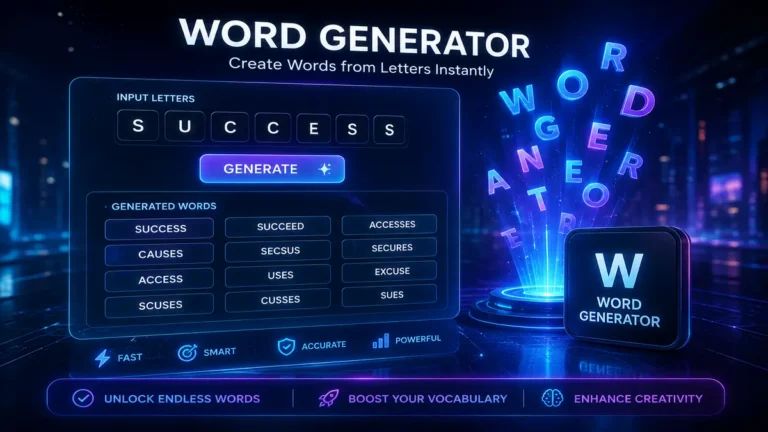
A word scramble unscrambler is a digital tool that takes a set of jumbled letters and rearranges them into every possible valid English word. Think of it as a dictionary with superpowers — one that doesn’t just define words but actively finds them from the chaos of mixed-up letters.
At its core, the tool is a word unscrambler that cross-references your input against a massive word database. Within milliseconds, it delivers a complete list of words you can form, typically organized by word length so you can find the highest-scoring plays first.
More Than Just a Cheat Sheet
Here’s what separates a quality word scramble unscrambler from a basic anagram generator: it doesn’t just rearrange all the letters into one word. It finds every combination — two-letter words, three-letter words, and everything up to the full set. That means you’re not just finding one answer; you’re uncovering an entire landscape of possibilities.
Whether you’re trying to unscramble words for a competitive match or simply working through a daily word puzzle over coffee, the right tool transforms the experience from frustrating to genuinely fun.

How Does a Word Scramble Unscrambler Work?
Behind every great word scramble unscrambler is a surprisingly elegant process. Understanding how it works helps you appreciate the tool — and use it more effectively.
The Algorithm Behind the Magic
When you enter scrambled letters into a scrambled words solver, the tool doesn’t randomly shuffle your letters and hope for the best. Instead, it follows a systematic process:
- Letter analysis: The tool catalogues every letter you’ve entered, noting duplicates and frequency.
- Permutation generation: It generates all possible arrangements of those letters in groups of two, three, four, and so on.
- Dictionary matching: Each permutation is checked against a verified word dictionary — often containing over 200,000 entries from sources like Merriam-Webster and official game dictionaries.
- Results display: Valid matches are returned, sorted by length, point value, or alphabetical order depending on the tool.
The entire process happens in fractions of a second. What would take you minutes of manual trial and error takes a letter unscrambler less time than it takes to blink.
Wildcards and Blank Tiles
Advanced word scramble unscrambler tools let you input wildcard characters — usually represented by a question mark or asterisk — to stand in for blank tiles or unknown letters. This is particularly useful in Scrabble and Wordfeud, where blank tiles can represent any letter.
For instance, if you have the letters A, P, ?, L, E, a good unscrambler will show you words like APPLE, PLACE, LEAPT, and MAPLE — swapping the wildcard for whichever letter completes each valid word.
If you enjoy finding hidden words in jumbled letters, you’ll also love our deep dive into how to find words from letters using proven techniques. For expanding your word knowledge beyond games, check out our guide on vocabulary building to discover better words for every situation.
Why Every Word Game Player Needs a Scrambled Words Solver
You might be thinking: “Isn’t using a word scramble unscrambler just cheating?” That’s a fair question, and the answer is more nuanced than you’d expect.
It’s a Learning Tool, Not Just a Shortcut
The best players don’t use a word scramble unscrambler as a crutch. They use it as a teacher. Every time the tool reveals a word you didn’t know, that’s a vocabulary lesson delivered in context — the most effective way to learn and retain new words.
Think about it this way: if you enter AEIRST and the tool shows you SATIRE, STRIAE, and AIREST, you’ve just learned two words (striae and airest) that you’ll recognize and remember next time they’re available on your rack.
Leveling the Playing Field
Word games have a steep learning curve. Experienced players know thousands of obscure two-letter words and high-value combinations that newer players have never encountered. A scrambled words solver bridges that gap, letting you compete meaningfully while you build your word knowledge organically.
If you play Wordfeud, you already know how demoralizing it can be to face an opponent who seems to pull seven-letter words out of thin air. A word scramble unscrambler helps you understand how they do it — and eventually, you’ll start seeing those words on your own.
Speed and Confidence
In timed word puzzles, hesitation is your worst enemy. Even if you eventually find the right word, the seconds you spent second-guessing yourself cost you points. Using an unscrambler during practice sessions trains your brain to recognize letter patterns faster, making you quicker even when you’re playing without assistance.

Step-by-Step: How to Unscramble Words Like a Champion
Whether you’re using a digital word scramble unscrambler or trying to decode letters in your head, there’s a method to the madness. Here’s the approach that top word game players swear by.
Step 1: Identify Common Letter Pairs
Before you even touch a tool, train your eyes to spot common letter combinations. Pairs like TH, SH, CH, QU, and ING appear in thousands of English words. When you see these clusters in your scrambled letters, mentally group them. This instantly reduces the complexity of the puzzle.
For example, if your letters are G, N, I, H, T, S, spotting the “ING” cluster immediately points you toward words like NIGHTS, THINGS, and SIGHTING.
Step 2: Look for Prefixes and Suffixes
English is a language built on patterns. Common prefixes (UN-, RE-, PRE-, DIS-) and suffixes (-ED, -ING, -TION, -LY, -ER) show up constantly. When you mentally separate these from the remaining letters, you often reveal the root word hiding underneath.
This is exactly what a word scramble unscrambler does algorithmically — but with practice, your brain can learn to do it instinctively.
Step 3: Start Small, Then Build Up
Don’t try to find the longest word first. Start with two- and three-letter words. This has a practical purpose: in games like Scrabble, short words placed strategically on premium squares often score more than longer words in dead zones.
Once you’ve identified the smaller words, use them as building blocks. Adding a letter to a three-letter word often reveals a four- or five-letter word you hadn’t noticed.
Step 4: Use the Tool to Verify and Discover
After you’ve done your best manual work, enter your letters into a word scramble unscrambler like the one available at WordWizy. Compare the tool’s results to what you found on your own. The gap between your list and the tool’s list is your learning opportunity.
Quick Reference: Common High-Value Short Words
Keep these in your mental toolbox — they appear frequently and score well:
- QI — A vital force in Chinese philosophy (valid in most word games)
- ZA — Slang for pizza
- XI — Greek letter
- JO — Scottish term of endearment
- AX — A chopping tool
- EX — Former partner or the letter X
Before diving into advanced techniques, make sure you have mastered the fundamentals. Our guide to word puzzle strategies covers powerful methods that apply to every word game. You might also explore how brain training games can sharpen the mental skills you need for faster unscrambling.
Advanced Strategies for Solving Scrambled Words
Once you’ve mastered the basics, these advanced techniques will take your unscrambling skills to the next level.
The Vowel-Consonant Separation Technique
Mentally divide your scrambled letters into vowels and consonants. English words follow predictable vowel-consonant patterns (CVC, CVCC, CCVC, etc.). By separating the groups, you can more easily see which combinations produce pronounceable — and therefore likely valid — words.
If your letters are B, E, A, R, T, L, separating them into vowels (E, A) and consonants (B, R, T, L) helps you construct combinations like TABLE, BLEAT, and ALTER more efficiently.
Anagram Awareness
Many words are anagrams of each other — they contain the exact same letters in different arrangements. LISTEN and SILENT. EARTH and HEART. TASER and RATES. A good word unscrambler reveals all these anagram pairs, and knowing them gives you multiple options from a single letter set.
Training yourself to think in anagrams is one of the most powerful skills you can develop. Every time you learn a new word, ask yourself: what other words can these same letters spell?
Pattern Recognition Through Repetition
The human brain is a pattern-recognition machine. The more you use a word scramble unscrambler, the more letter patterns you internalize. After a few weeks of regular use, you’ll start recognizing word possibilities before you even type the letters in. That’s not a gimmick — it’s how your brain naturally processes repeated exposure to linguistic patterns.
WordWizy’s Word Scramble Unscrambler: Your Competitive Edge
Not all word scramble unscrambler tools are created equal. Some are slow. Some use outdated dictionaries. Some drown you in ads before you even see your results. That’s why choosing the right tool matters as much as knowing how to use it.
What Sets WordWizy Apart
WordWizy was built by word game enthusiasts who were tired of clunky, ad-heavy unscrambling tools. The result is a fast, clean, and powerful word scramble unscrambler that prioritizes your experience.
Here’s what you get:
- Instant results: Enter your letters and get every valid word in under a second. No loading screens, no waiting.
- Multiple game dictionaries: Whether you play Scrabble (TWL/SOWPODS), Wordfeud, or Words With Friends, WordWizy matches the right dictionary to your game.
- Wildcard support: Use question marks for blank tiles or unknown letters. The tool handles them intelligently.
- Results sorted by length and value: Find the highest-scoring word instantly, or browse by word length to find strategic plays.
- Mobile-friendly: Works seamlessly on your phone, so you can use it wherever you play.
The Full WordWizy Toolkit
The word scramble unscrambler is just one piece of WordWizy’s suite. You also have access to a dedicated Word Unscrambler for straightforward letter-to-word conversions, an Anagram Solver for finding word pairs with identical letters, and a Wordfeud Helper tuned specifically for Wordfeud’s unique rules and dictionary.
Together, these tools give you a complete arsenal for any word puzzle situation you’ll encounter.
Want another powerful approach to word discovery? Our letter combination tool guide shows you amazing ways to find words by combining letters in patterns you might never have considered.
Word Scramble Unscrambler for Education and Brain Training
A word scramble unscrambler isn’t just for gamers. Educators, students, and anyone interested in keeping their mind sharp can benefit from these tools in ways you might not expect.
Vocabulary Building That Actually Works
Traditional vocabulary lists are boring and ineffective. You memorize a word for a test, then forget it a week later. A word scramble unscrambler flips that approach on its head.
When you discover a new word through unscrambling, you encounter it in an active problem-solving context. Your brain forms stronger memory connections because you worked to find the word rather than passively reading its definition. Research in cognitive psychology consistently shows that active retrieval beats passive review for long-term retention.
Classroom Applications
Teachers are increasingly using word scramble activities in their lesson plans. A word scramble unscrambler serves as the answer key, letting educators quickly generate and verify word puzzles tailored to their curriculum. Spelling lessons, vocabulary units, and even foreign language classes can all benefit from scramble-based exercises.
For students, the gamification aspect makes learning feel less like homework and more like play. When you’re trying to beat a puzzle, you don’t notice that you’re also learning.
Cognitive Benefits for All Ages
Word puzzles exercise your working memory, pattern recognition, and linguistic processing centers simultaneously. Regular engagement with word scramble challenges has been linked to improved cognitive flexibility — your brain’s ability to switch between different concepts and think about multiple ideas at once.
For older adults, word puzzles offer a particularly valuable form of mental exercise. They’re engaging enough to do consistently, challenging enough to provide real cognitive stimulation, and satisfying enough to keep you coming back. A word scramble unscrambler keeps the activity enjoyable by ensuring you never get permanently stuck.

Playing Wordfeud or similar competitive word games? Do not miss our Wordfeud assistance guide for game-specific tips. Learning how to use synonyms effectively can also expand the word options you spot during unscrambling.
Common Pitfalls and How to Avoid Them
Even with a powerful word scramble unscrambler at your fingertips, there are mistakes that can hold you back. Watch out for these common traps.
Pitfall 1: Over-Reliance on the Tool
The goal is to use the word scramble unscrambler as a training partner, not a permanent crutch. If you never try to unscramble words on your own first, you’re robbing yourself of the mental workout that makes you a better player over time. Always attempt the puzzle manually before reaching for the tool.
Pitfall 2: Ignoring Short Words
New players often fixate on finding the longest possible word and overlook the two- and three-letter words that actually win games. In Scrabble and Wordfeud, a well-placed two-letter word on a triple-letter score can be worth more than a five-letter word in the middle of the board. Your letter unscrambler shows you all word lengths — pay attention to the short ones.
Pitfall 3: Using the Wrong Dictionary
Not all word games use the same dictionary. A word that’s valid in Scrabble’s TWL dictionary might not exist in the SOWPODS dictionary used in international play, and Wordfeud has its own accepted word list. Make sure your word scramble unscrambler is set to the correct dictionary for your specific game. WordWizy handles this automatically, but not every tool does.
Pitfall 4: Forgetting About Board Position
A word scramble unscrambler tells you what words you can make, but not where to place them. The highest-scoring word on your rack isn’t always the best play. Consider premium squares, defensive positioning, and what letters you’re leaving yourself for future turns. Strategy is still your job — the tool handles the vocabulary side.
Pitfall 5: Not Learning From Results
Every time the unscrambler shows you a word you didn’t know, take a few seconds to learn it. Look up the definition. Say it out loud. Use it in a sentence. Those few seconds of effort convert a one-time answer into permanent vocabulary knowledge.
Frequently Asked Questions About Word Scramble Unscramblers
What is a word scramble unscrambler?
A word scramble unscrambler is an online tool that takes a set of jumbled or scrambled letters and identifies every valid English word that can be formed from those letters. It works by comparing all possible letter combinations against a verified dictionary, returning results organized by word length or point value. You can use it for word games, puzzles, educational activities, and vocabulary building.
Is using a word scramble unscrambler considered cheating?
That depends entirely on context. In casual games and practice sessions, most players consider it a legitimate learning tool — similar to how a chess player might use an engine to study after a game. In formal competitions, external tools are typically not allowed. The most effective approach is to use a word scramble unscrambler during practice to build your vocabulary, then rely on your own knowledge during actual games.
How many words can a word scramble unscrambler find from a set of letters?
The number of results depends on the letters you enter and the dictionary the tool uses. A typical set of seven letters can yield anywhere from a dozen to over a hundred valid words, ranging from two-letter words to the full seven-letter combination. High-frequency letters like E, A, R, S, and T tend to produce more results, while uncommon letters like Q, Z, X, and J generate fewer but often higher-scoring words.
Can a word scramble unscrambler help me improve at Scrabble and Wordfeud?
Absolutely. Regular use of a word scramble unscrambler exposes you to words you wouldn’t encounter through normal reading or conversation. Over time, you internalize these words and the letter patterns that form them. Many competitive Scrabble players credit unscrambling tools as a key part of their study routine, using them to drill anagram recognition and discover obscure but high-scoring words.
Does a word scramble unscrambler work with blank tiles or wildcard letters?
Yes, most quality word scramble unscrambler tools support wildcard characters. On WordWizy, you can use a question mark (?) to represent a blank tile. The tool will test every letter of the alphabet in that position and return all valid words. This feature is especially useful for Scrabble and Wordfeud, where blank tiles can represent any letter.
What’s the difference between a word scramble unscrambler and an anagram solver?
While the terms are sometimes used interchangeably, there’s a meaningful difference. An anagram solver typically rearranges all the given letters into a single word or phrase — every letter must be used. A word scramble unscrambler finds words using any combination of the given letters, including subsets. So if you enter six letters, the unscrambler will show you valid two-, three-, four-, five-, and six-letter words, while an anagram solver focuses on six-letter results.
If you are a content creator who uses word tools for writing as well as games, you will find value in our tips for crafting better headlines and understanding long-tail keywords to boost your content reach.
Conclusion: Stop Staring at Scrambled Letters and Start Winning
Every word game player reaches a point where natural vocabulary isn’t enough. The difference between a good player and a great one isn’t just knowing more words — it’s having a systematic approach to finding them. A word scramble unscrambler gives you that system.
You’ve learned how these tools work, why they’re valuable for both competition and learning, and how to use them strategically without becoming dependent on them. You’ve picked up advanced techniques like vowel-consonant separation and anagram awareness. And you’ve seen how a word scramble unscrambler fits into a broader toolkit alongside dedicated word unscramblers, anagram solvers, and game-specific helpers.
Now it’s your turn to put all of this into action.
Head over to WordWizy’s Word Unscrambler and try it with your next set of scrambled letters. Whether you’re prepping for a Wordfeud match, working through a daily word puzzle, or just curious about what words are hiding in your name, WordWizy’s word scramble unscrambler has your back. It’s free, it’s fast, and it might just be the tool that turns you from a casual player into the person everyone dreads facing across the board.
Your letters are waiting. Go unscramble them.